Conventional climate science gives the right answers. Alternative explanations do not. Oil-giant, Exxon, has known this for over forty years and supressed the evidence.
The hallmark of good science is successful prediction, in advance, of the outcomes of experiments and observations yet to be made. The hypothesis, that human activities are warming the Earth, does precisely that.
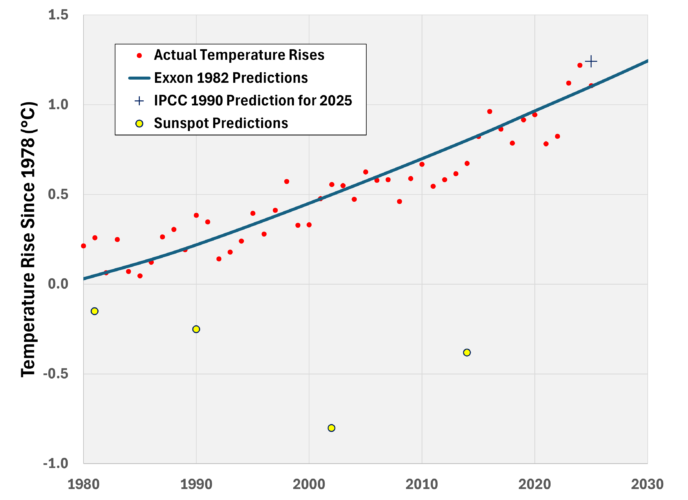
In 1990, the first report from the Intergovernmental Panel on Climate Change (IPCC) predicted that “business as usual” would “result in a likely increase in global mean temperature of about 1°C above the present value by 2025”. Data from Our World in Data shows that the temperature in 2025 was 0.91°C above the 1985-1995 average.
A more shocking example is that scientists working for oil-major, Exxon, predicted in 1982 that global temperatures would rise by 1.1 °C between 1980 and 2025. Forty-three years after the predictions were made, that’s exactly what was seen (2025 was 1.08 °C above the 1975-1985 average). To their shame, Exxon (and then ExxonMobil) supressed this clear and accurate understanding of manmade climate change until it was uncovered by journalists in 2015.
In contrast, alternate explanations of climate change fail the test of making successful predictions.
For example, a paper written in 1991 linked the durations of previous sunspot cycles to warming. However, since the paper was published, there have been three further sunspot cycles. The durations of these completely fail to correctly reproduce the observed global temperatures. Sunspot cycle lengths predicted temperatures that were 0.5 – 1.3 °C colder than observed.